
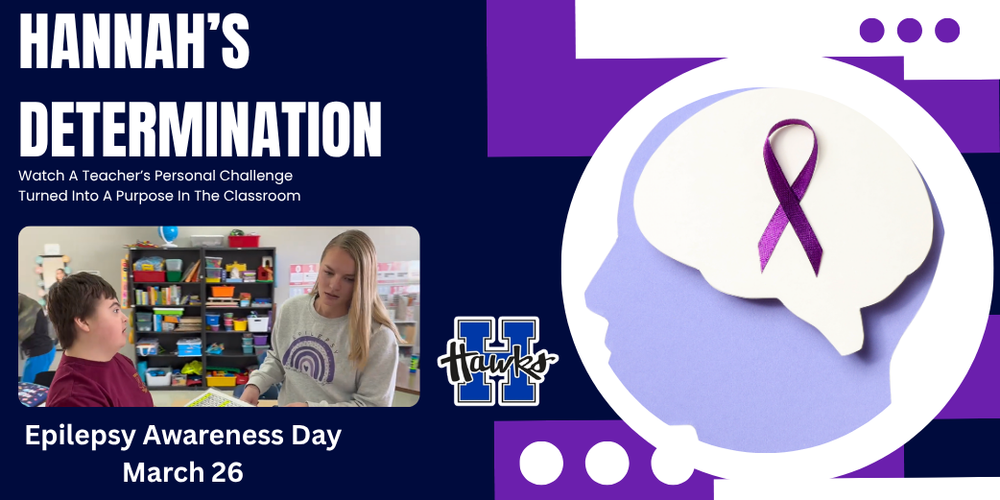
Hannah Rice (2020 Hillsboro High Grad) spends her days helping students at Hillsboro Intermediate School overcome challenges in the classroom. As a special education teacher, she builds strong relationships with her students and helps guide them through obstacles many people never see.
What some may not realize is that Rice understands those challenges in a very personal way.
Rice has epilepsy. Getting that diagnosis, however, took years.
Her seizures began when she was 14 years old, but doctors initially struggled to identify what was happening. Several medical professionals suggested anxiety or normal teenage changes. But Rice and her parents knew something wasn’t right.
Her mother, Trisha Watson, trusted her instincts.
“It was a long battle,” Trisha said. “But as a mom, if you have that gut feeling that something isn’t right, you keep pushing. My husband and I stuck to our guns. We kept doing our research and questioning doctors until we finally had answers.”
Those answers eventually came from the Mayo Clinic in Minnesota.
“After we went up there for the first time, they diagnosed me with Partial Complex Epilepsy within a month,” Rice said. “Doctors closer to home had been trying to figure it out for almost four years. If it wasn’t for my mom, I don’t know where I’d be.”
Today, Rice is thriving. She is married, teaching special education, and continuing her education while pursuing a master’s degree.
Her type of seizures are not the traditional kind many people imagine. She does not collapse or experience full-body convulsions, which is one reason doctors struggled to identify her condition early on.
Her mother believes the experience helped shape who she is today.
“We’ve always told her epilepsy has shaped her, but it hasn’t defined her,” Trisha said. “It has helped make her the compassionate person she is. Special education is the perfect fit for her.”
At Hillsboro Intermediate School, Rice’s dedication to students is clear. Teaching special education requires patience, understanding, and strong relationships with students and families. For Rice, that connection is especially meaningful.
Her coworkers also understand the realities of her condition and are prepared if she experiences a seizure at school.
Outside the classroom, there are daily adjustments. Rice cannot drive and relies on family and friends for transportation. The longest stretch she has gone without a seizure is 53 days. A milestone her family celebrates.
“That’s an exciting day,” Rice said. “My husband will send me flowers, and my parents will send me flowers. They know it’s a big deal.”
Rice also uses a medical device called a stimulator, implanted in her chest, which sends electrical impulses to the brain to help reduce seizures.
Despite the challenges, Rice focuses on the positives and the work she loves.
“I think getting my career established helped a lot,” she said. “I look at my seizures now more like a detour. I try to have a positive outlook.”
That outlook carries into her classroom every day.
March 26th marks Epilepsy Awareness Day, a time to raise awareness and show support for those living with the condition. Rice hopes her story reminds others that epilepsy does not define a person’s potential.
Sometimes, it simply becomes part of the journey.